June marks the 30th anniversary of Rosewood Marketing (originally Rosewood Design). When we began, we quickly discovered a significant gap among Plain Community businesses: a lack of graphic design services from someone within the community—someone who truly understands and respects its values.
Based on our customers’ needs, we soon added photography, website development, and other marketing services to our offering. Since 1996, we have been endeavoring to help Plain Community businesses improve their marketing God’s way. Today, Rosewood Marketing is a full-service agency. We start our client service engagements by developing a deep understanding of their business. Then we collaborate with them to develop a marketing strategy and a 12-month plan that aligns the unique strengths of their business with unmet needs in the marketplace.
This has given me the privilege of seeing deep inside dozens and dozens of businesses, and the ability to watch things change over the last three decades. I’ve gotten to see the good, bad, and ugly in our businesses. (By the way, almost every business has experience with all three.) This inside look has given me a tremendous appreciation for the values and heritage of biblical Christianity that so many of us care deeply about.
I want to share a bit of my perspective to help you make better business decisions today that will create sustainability for the coming generations. And not just financial sustainability, but perpetuating the things that matter most: family relationships, community fabric, and our spiritual heritage.
Over the last 50 to 75 years, our people have moved from primarily farming-centered families to family members working in business. This change was primarily driven by the changing economics of farming. This change brings with it unique challenges. We knew how to sustain operations on the farm in a way that built strong families and communities. But now it’s different.
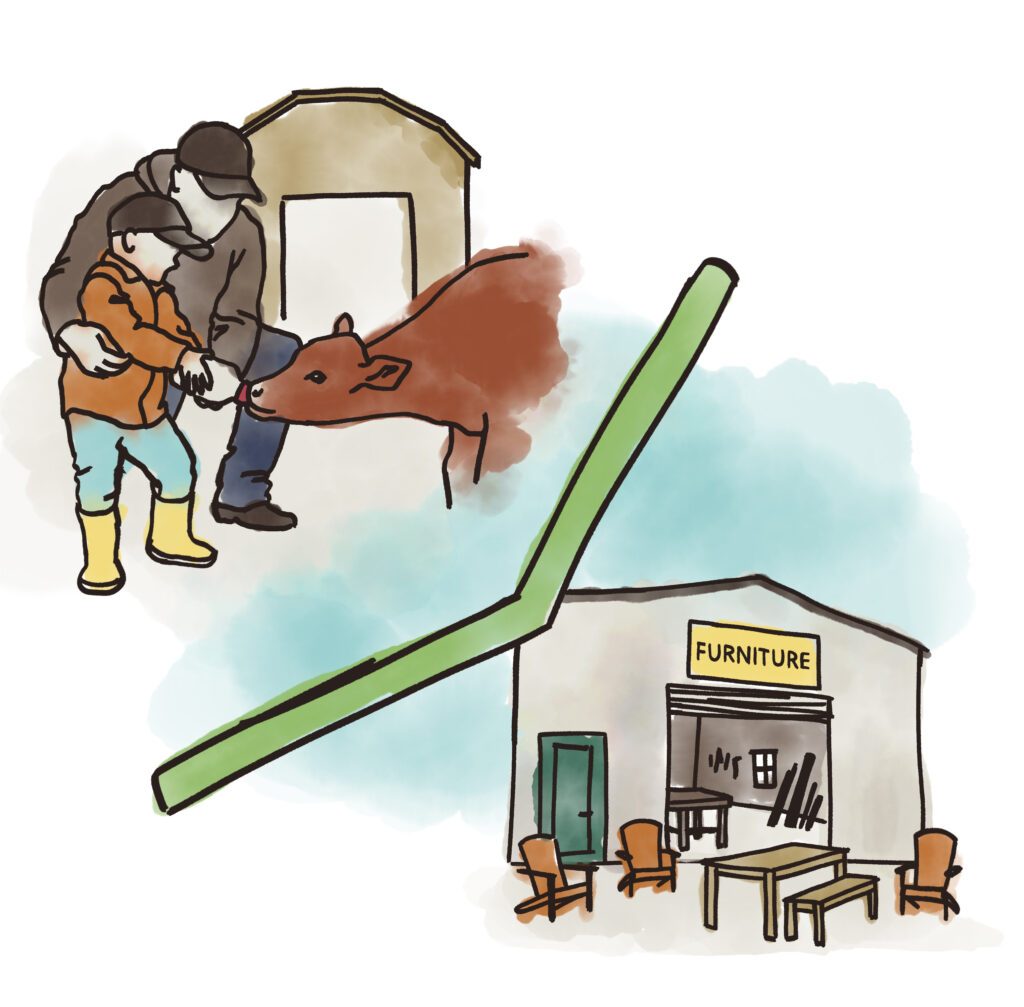
Business is the new farm
Anabaptists are trying to figure out how to propagate our family values and our faith in this new world of business. The generation ahead of me pioneered this movement. In the process, they learned some hard lessons. My generation is benefiting tremendously from their mentorship and experience. However, on the whole, we are still figuring out how to best sustain healthy families, churches, and communities with business as the new farm.
We need to work together to figure out how to run healthy businesses and grow healthy family relationships at the same time. Businesses should bring our families and communities together, not create separation. By learning from those who’ve gone ahead of us and collaborating with those who are coming behind us, we can develop ways of doing business that sustain all dimensions of life.
Business has brought with it many opportunities to interact with those outside our own people. This is a real opportunity for us to be a blessing because people today are starving for genuine human connection. As a Plain Community, caring for people is a strength.
Agricultural life was valued for its relevance to faith. Something about working with the soil, growing crops, and raising animals brought a sense of God’s presence and glory into our lives. This is a loss that some are still grieving, and understandably so, but let’s recognize that God’s glory and presence are found in other sectors as well. The science in other vocations, such as construction, manufacturing, or baking, also bears God’s fingerprints.
The headwinds our small businesses face
In the next few paragraphs, I’d like to highlight several areas you should pay attention to in your business. These items vary from community to community, so use this more as a checklist and mark what applies to you.
In our agricultural background, we had a wonderful culture of neighbors helping neighbors. We were happy to share tips and ideas about how to raise better crops and healthier animals. This kind of shared knowledge and copying one another’s good techniques worked out very well. It helped us build a generational well of knowledge and wisdom around farming.
However, as we have moved into business, our practice of copying our neighbors’ success is actually shooting us in the foot. Too often, someone who wants to start a business looks down the road, sees an apparently successful business, and decides they can do the same thing. This copycat strategy only creates competition that can sour relationships between neighbors. Instead, we should look for another opportunity that allows both their business and ours to serve unique needs in the community. New opportunities can be discovered through R&D (Research and Development), rather than using it to mean “rip off and duplicate.”
In our traditional farming setting, there is generally a respect for everyone on the farm, from the youngest to the oldest. The aged were respected for their wisdom and experience, and the young were respected for their strength and resilience in getting the heavy manual labor done on the farm.
However, as we move into business, it’s very easy to develop a mentality that the business owner or leaders higher up in the organizational chart are more important than those lower down. There is a strong tendency, maybe especially in American culture, to value people based on perceived financial status. This is a worldly view of the value of people. We need to remember that, regardless of someone’s duties in the business, each person is valuable. After all, if the janitor isn’t emptying the trash cans, everyone has a problem. The nature of supply and demand does create compensation differences among various roles, but this is not because they are more significant human beings in God’s eyes.
Money is only one measure of value. Jesus said that the way we steward the physical resources we have is a prerequisite for entrusting us with “true riches.” This suggests that one’s usefulness in God’s economy has more to do with our stewardship practices than how much we have to steward.
This stewardship goes far beyond just money. We should steward our relationship with God, our influence with others, our physical bodies, our emotional health, and our time. These are areas of “true riches” that we can use to bless one another and lay up treasures in heaven. Isn’t it true that the way we use our finances is driven primarily by how we view stewardship in the other areas of life? Perhaps this is why Jesus uses our financial decisions as a basis for entrusting more “true riches” to us.
The rich, and that probably means you, are admonished to be “willing to distribute.” Jesus said, “To whom much is given, much is required.” As business owners and leaders, we should be examples of selfless generosity. We should also be “rich in good works,” taking time to help others.
Another closely related area is maintaining relationships with family and other church members in the business. The more ways that you’re connected to a person, the more complex the relationship gets. It’s one thing to maintain a good relationship with your brother. It’s another thing to maintain a good relationship with your brother, who is also your employee. It’s still another thing to maintain a relationship with your brother, who is your employee and your deacon at church. It requires careful thought to keep the lines clear between family relationships, work relationships, and church relationships. It is important to be intentional so that we can strengthen relationships instead of allowing the complexity to destroy them.
While there is no easy solution to these complex dynamics, I’ll offer three ideas that I’ve found helpful in multi-dimensional relationships.
- Make sure you wear only one relationship hat in a conversation. Avoid talking about work and church issues in the same conversation, especially if emotions are running high.
- Invite an experienced third party into the challenging conversations to moderate the discussion. This helps to keep the conversations focused and more productive.
- Listen deeply and give space to draw the other person out. Discern how they are feeling. Sam Gingerich, a Christian counselor, says, “Listen beneath the words.”
Another area to consider is our engagement with outside professionals such as CPAs, attorneys, and business coaches. These professionals can provide valuable insight into the daily operations and functions of our companies, but we need to be careful not to assimilate worldly thinking from those who do not understand our biblical worldview. It can sometimes be difficult to discern between what is truly godly wisdom and the wisdom of this world. When something doesn’t feel right to you, it’s good to pray about it and seek counsel from trusted brothers around you to discern the best way forward.
The last area I’d like to point out is the challenge of learning to lead and manage well in our businesses. The more leadership and management responsibility someone has, the deeper and richer one’s character needs to be to play their role well in a God-honoring way. Most leadership and management books and education available today focus on the skills of leading and managing. Very little focuses on the character or virtues that a Christian leader should acquire to lead well. This is an area where each one of us has a lot of room to grow.
I hope that mentioning these areas of need does not create discouragement, but rather that it encourages us to work together to develop a rich well of wisdom and knowledge in our communities that can be shared generationally, just as we had a rich well of wisdom and knowledge around farming.
The three major functions in every business
Every business has at least three major functions. There are sometimes more, but I’m going to stick with three main ones for this article. First, every business has a major function of operations. Operations comprise the main work of the business. It’s the bakery that bakes the cakes. It’s the shop where the equipment is manufactured, or it’s the trucks and the crew that work on the construction on site.
As a community, we do very well with operations. This is in our DNA. We have practical minds that love to solve mechanical problems. We like to get our hands on the materials. We are good at building high-quality products. We know how to improve the efficiency in the shop. Our strong work ethic also contributes to operations being a healthy part of our businesses.
Another major function is finance. Most of us don’t enjoy the office as well as the shop, but there are two things that we have in our favor that help us to do reasonably well in the major function of finance:
First and by far the most important is our morals. We will make sure that our bills get paid, and if we don’t, our brothers will help us do that.
Secondly is the IRS. They are looking over our shoulder every year, and this brings a healthy accountability to the finance department. We have done a reasonable job in the major function of finance.
The third major function of every business is sales and marketing. As a community, we range from skepticism to active resistance when engaging in this area. Our perception is that, like the stereotypical used car salesman, we cannot quite trust what happens here. Marketing has earned this reputation for good reason. Most of the marketing that we see in our world today is not based on biblical values. Worldly values influence a lot of what we see in marketing, but there is a better way. It is possible to do marketing God’s way, and the primary difference between marketing the world’s way and marketing God’s way is that worldly marketing focuses first on the back pocket of the shareholder, while the well-being of the consumer is second place at best. To market God’s way, we need to reverse that and put the consumer’s well-being first. When that’s done in a healthy market context, the business owner’s back pocket will be taken care of.
Many of our Plain Community businesses have done very well due, in many cases, to our amazing gifts in the major function of operations and sufficient know-how in finance. When it comes to the major function of marketing, it’s more likely that good intuition about what the market needed or a stroke of luck contributed to strong sales. When a company develops a highly desired product or service, word of mouth kicks in, and a business can be successful even if its marketing is less than stellar.
And this can be fine while it lasts, but I’ve seen companies crumble who haven’t paid attention to what was really driving their sales. This unraveling of a successful business can be confusing, frustrating, and costly. There are emotional, relational, and sometimes even spiritual tolls in these circumstances.
I hope that these reflections will help you make better business decisions today that will ensure sustainability for future generations. I hope that in thirty years from now (2056) our people will be enjoying the blessings of businesses that are strengthening the cords of family relationships, community fabric, and our spiritual heritage.
A Sneak Peek into the Next Article
Next month, we take a deep dive into The Critical Role of Marketing Foundations. To consistently thrive in stable businesses over the generations, we need to understand what the foundations of marketing really are. The foundations of marketing are a lot like the 90% of the iceberg that’s underneath the waterline. It’s not easy to see, but it’s actually what catches the current and moves the iceberg along. Watch for the article next month to take a deep dive below the water line and look at the foundations of marketing that matter most.