Bluetongue* hit hard—so hard that Mike at Mike’s Meats knew without a doubt that this fall and winter were going to be very different. Bluetongue was decimating the white-tailed deer population so drastically that the Game Commission was actually issuing refunds to hunters who already had their deer tags for the upcoming season. And Mike was right in the middle of it: he could not have been more geographically centered in the Bluetongue epidemic, and the blow to Mike’s business could not have been more direct. No hunters would be bringing in deer this fall!
Mike intuitively knew that he would have to do something different and do it quickly. Otherwise, his cash would dry up, and the ramifications of no income stream were sobering. Not making loan payments, laying off the team he had so carefully trained, not supplying his own family’s needs—the stakes were high.

Perhaps you have experienced something like Mike’s Meats. Perhaps even now, you have a malodorous whiff; ominous change is in the air, change that might negatively impact your industry.
An industry downturn can occur for various reasons. It can be due to epidemics in deer or people, such as bluetongue or COVID. It can be from unfavorable interest rates, making mortgages difficult or out of reach. It can be a new technology that forever changes what had been your bread and butter. Public sentiment can also turn against your products.
Caught in a Downturn
A framing contractor, who had several crews in the field, suddenly found that new home construction came to a standstill. Even jobs he already had on his calendar were cancelled—why? A housing crash induced by steep hikes in interest rates, coupled with banks tightening loan policies, dried up the new construction industry so quickly that few people even saw it coming.
An electrical generator refurbishing company began to feel the squeeze as the industry became overcrowded with competition. Acquiring used equipment became too expensive; as the demand increased, the players in the field literally priced each other out of the used generator market. The situation became so acute that it was “pivot or die.”
A furniture manufacturer used to be able to sell as many dining sets as he could scale operationally. But after he was heavily leveraged in debt and tooled up with machinery and team members, offshore furniture began to nose into the marketplace. And the quality, like it or not, wasn’t really all that bad. Customers were happily buying it at a price he simply couldn’t match.
Tariffs, trade laws, overseas developments, interest rate moves, changing laws, new technologies, and a host of other factors can spawn an industry downturn.
As you know, risks are a normal part of free enterprise. But they must be managed.
A Winning Mindset
The best time to prepare for a downturn is before it happens. If industry downturns are going to be successfully navigated, you must start to see changes as possibilities, not problems. The key to weathering and thriving during downturns is being able to pivot operations without sacrificing your purpose or core values. This article will show how to emerge better, stronger, and perhaps even bigger (if you wish) after an industry downturn. But it won’t happen without intentional and preemptive thinking.
Successful entrepreneurs can use marketing effectively to pivot operations not only to survive but also to thrive during downturns and recessions.
First, let’s look at a few key terms.
Fixed Expense: Operational costs that are not directly charged to your customer. For a building tradesman, fixed expenses include cordless drills, generator fuel, pickup truck maintenance, and insurance—all things he can never put as line items on customers’ invoices.
Cost of Sales: Money you pay for goods and services that are chargeable directly to customers. For example, the home builder will charge for the lumber, roofing supplies, and all materials required for the project. Cost of sales is also frequently called Cost of Goods Sold (COGS).
Asset: Something that generates value or assists in creating value. It might be a machine that takes raw material and turns it into sellable widgets; it might be a business vehicle that transports you or materials and tools to a jobsite. It can be a process, recipe, or formula that produces a valuable outcome.
The Need for and Contribution of Marketing
Fixed expenses, cost of sales, and assets aren’t only operational line items; they can also be marketing line items. Think of marketing as a machine in which you invest to generate customers. If your machine gives you $1.00 back for every $.25 you put into it, you’d be eager to put in as many quarters as you can! A well-oiled marketing machine can do exactly that.
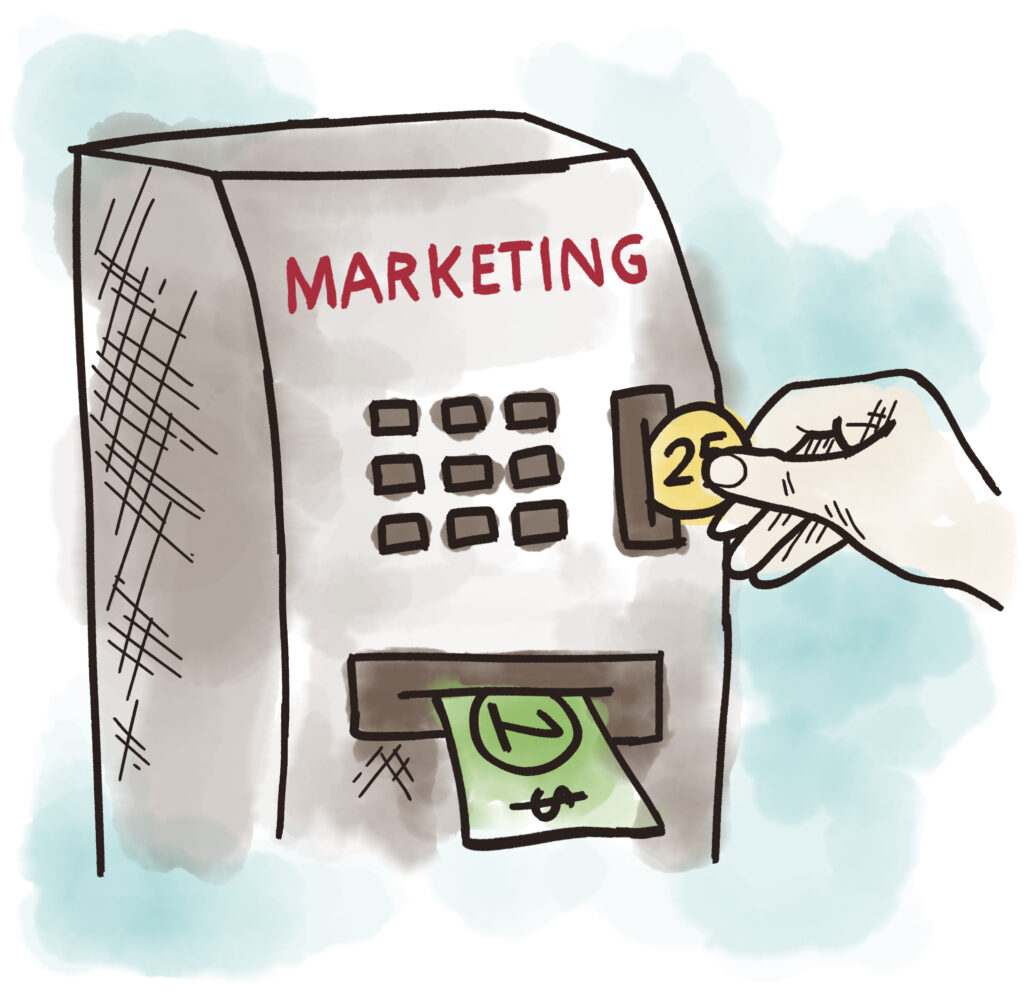
So is marketing an expense or an asset?
Bills for printing brochures, running ads, and developing your website are categorized as expenses by your accountant. They obviously require cash and won’t be billed directly to your customer.
During a downturn, cash is often tight and becoming tighter. Business owners start looking over their expense line items to see where they can save money. That is generally a good idea. Too many times, though, the marketing expense line gets treated like all the rest: if we don’t absolutely need it to get through the next month, we cut it.
Yet, if marketing works as it should, the expenditure will turn the wheel of profitable business. In fact, highly successful marketing programs may eventually show up on a balance sheet as an intangible asset or intellectual property. For example, you can’t throw a Coke label on your product because that would be stealing something of value. Franchise fees are based in part on the marketing system and brand value they have built. McDonald’s will have plenty to say if you start a burger joint and call it McDonald’s.
What’s the point of all this? Marketing does have a cost, but ignoring what it can bring to your business may lead you to cut off your only lifeline, especially in a downturn or recession. When stressed and cash-strapped, making healthy business choices is doubly difficult. But marketing expenses may be the quarter invested that brings in the dollar.
Marketing During Downturns
Remember the framing contractor? While the crews were busy before the downturn, he had already been conducting informal but extensive market research on wood and composite decks. He had turned down several opportunities to build expansive decks because they didn’t need the work and had more than enough framing jobs already. Yet the idea intrigued him enough that he investigated the possibility of someday pivoting to this type of service should the need arise. He had observed a company that prebuilt decks and delivered them with a mini-barn type trailer, especially to mobile homes. He already knew that the county to the south, further from the upscale suburbs, had many mobile home dealers.
So when house framing tanked, he pivoted to being a comprehensive deck company. He offered both pre-builds and on-site builds. A friend had a mini-barn company that did the deliveries to get started. He marketed directly to owners of homes he had built recently that had a “future deck” option on the plans. Some of these previous contacts were ready to roll. He used direct mail to put flyers about decks in thousands of mailboxes. People responded. He also stopped in at those mobile home dealers to the south and gave them a sales manual, thus creating a dealer network. By the end of the downturn, when housing had fired up again, he had two viable businesses that were stronger than ever. By leveraging his existing tools, expertise, and suppliers, and supporting those endeavors with intentional marketing, he had pivoted and emerged strong.
The electrical generator refurbisher pivoted to manufacturing new units. This required extensive research and development, coupled with the help of a professional marketing team. Eventually, the shop had two divisions, one for refurbishing and one for new manufacturing. The sales team likewise now has two divisions, new and used.
The furniture manufacturer pivoted to building a dining room table that converted to a pool table, the only thing like it in the market. With proper marketing, the idea took off, and, eventually, the company pivoted to focus exclusively on the multi-use table. Having learned his lesson, the owner is currently devoting his time to other niche-market products that might broaden his product line and become the umbrella for the next rainy day.
What about Mike’s Meats? Mike had been doing some observation of his own before the blue-tongue epidemic temporarily wiped out a segment of his business. Another term for “observing” is research and development (R&D). R&D is foundational to effective marketing.
Some of Mike’s customers had been asking for mobile slaughtering service. Instead of hauling the live animals “on the hoof” to the butcher shop, they would be slaughtered on the customer’s property and transported to the butcher shop “on the hook.” Mike’s Meats had been referring these customers to the one and only mobile slaughter service that covered their region. But Mike was hearing more and more complaints about their service.
Mike had done his homework—when the epidemic hit, he was ready. He bought the mobile slaughtering equipment immediately, set up the truck, and advertised heavily. Almost overnight, the mobile slaughtering business sprang up. He also heavily advertised in an adjoining county, where he had discovered a need for both mobile slaughtering and meat processing. Again, through effective marketing, an expanding flow of livestock headed his way, both on the hoof and on the hook.
By hunting season next year, a new business entity had been formed and was owner-managed by his married son. Two mobile trucks were on the road full-time. This new enterprise created much more demand for the shop. So Mike started crunching numbers and drawing plans for an addition to the butcher shop. Today, Mike knows exactly how “put in a quarter, get out a dollar” applies to marketing, and he is assessing how many quarters he can practically invest and still sensibly scale the workload.
A Balancing Caution
People who thrive in the game of business do not expect willy-nilly marketing campaigns to fix all the problems of a business downturn. Note that in the examples given, proper prior research and development were done beforehand. This is an essential function of marketing. Also, the marketing method was correctly apprised, and effective venues were chosen and used.
Many businessmen feel like marketing money is wasted, and indeed it can be! If there is no corresponding return on sales, we tend to generalize and say, “Marketing doesn’t work!” However, it might also be the case that the wrong tool was employed, or that marketing was poorly executed or poorly tracked. In those cases, marketing can be a money drain with no returns. Drill a little deeper before concluding marketing is futile.
A Few Takeaways
First, operate your business circumspectly. Know what is going on around you and in your industry. What opportunities are available if a pivot is needed? What other options align with the skill sets and infrastructure you already have in place? Aim to have a solution or backup plan before a downturn forces you to act without proper research and knowledge.
Also, know that the way businesses respond internally to changing marketing dynamics has far more to do with success or failure than outside changes do. Keeping the marketing sails hoisted even during the doldrums enables your boat to be propelled by breezes the moment they arrive. Don’t wrap up the sails and wait for the wind to return. Leverage marketing to get them turned toward existing wafts, not the breezes that had been. The company that continues marketing during a down cycle can pick up new revenue streams, as well as expand market share readily when the upcycle begins.
Thirdly, focus on building a machine that constantly delivers sales. This means staying attuned to ups and downs, and changing the marketing messaging or even the business mission. “A quarter in, a dollar out,” is the way to a bountiful crop. Don’t turn off the irrigation pump when the forecasters are saying it’s going to be a dry year.
And lastly, while change is inherently unstable, know that this is life. Mother knows that growing boys need trousers that fit, and so she is constantly anticipating change and providing accordingly. The time will come when the old just doesn’t fit anymore, and the old will be awkward and even hurt. Like insurance, it’s nice when your business model and demand don’t require much marketing. But if you wait until it’s needed, it’s too late.
As Darren Hardy says, “Problems are where the money lies. Problems are the only reason businesses exist. Competitors are facing the same problems you are; the only difference is how you respond to them. Change your relationship with problems, and you’ll change the trajectory of your success.”
With proper marketing, you can emerge from a downturn stronger, not weaker.