The Sequel to Reflections on Thirty Years in Anabaptist Marketing
If you haven’t read “Reflections After Thirty Years in Plain Community Marketing,” you can find it in the June 2026 issue of the Plain Community Business Exchange or on our website, rosewood.us.com. In that article, I discussed how over the last 50 to 75 years, business has become the new farm in our Plain communities. Then I shared some thoughts about how we’re doing in the business world. Finally, I identified the three main functions that every business has:
- Operations, in which we do very well as a community
- Finance, in which we do reasonably well
- Marketing, in which we function somewhere between skepticism and active resistance
And now let’s explore the critical role of marketing foundations.
I have a growing conviction that for our communities to thrive in this new environment of business as the new farm, we need to figure out how to do marketing well. An important aspect of doing it well is learning how to do it God’s way. I have seen over and over that when someone understands how to do marketing God’s way, skepticism and resistance quickly evaporate.
We didn’t come by our skeptical view of marketing without good cause. A lot of marketing in our world today isn’t fitting for God’s people. Because of what we see, we ask questions such as these:
- Am I proud if I make grand statements about my products and draw attention to my business?
- Is it poor stewardship to waste money on expensive marketing that may or may not offer a return?
- Is marketing a legitimate occupation for a Christian?
- Is it even possible to market in a way that honors God?
In my book, Lessons from a Prodigal Marketer: How to Build Your Marketing on a Biblical Foundation, I share five Biblical principles through which we can evaluate our marketing. These five principal pillars rest on the foundation of love.
Truth: Truthful marketing gives people the right impression about our company and product.
Humility: Humble marketing replaces haughty statements about how great we are with helpful explanations of how the customer will benefit.
Contentment: Contented marketing targets only potential customers who will benefit from the transaction.
Service: Service-driven marketing educates and guides potential customers to make a good decision for themselves.
Stewardship: Well-stewarded marketing tests and measures results to continuously improve the return on investment of both our time and money.
With this Biblical basis as our guide, let’s consider the components of marketing. What is marketing? There have been many good definitions of marketing coined over the years. I would like to explain it as consisting of seven layers. Think of these seven layers of marketing resting on top of the five Biblical principle pillars, which rest on the foundation of love.
These seven layers can be separated into two primary groups. The bottom three layers are strategic. The top four layers are tactical.
Strategy
Layer 1: Company Culture
The bottom layer is company culture. David Bower, owner of Seven Oaks Landscaping and an Anabaptist Financial Advisor, said, “Culture is how you think and what you do.” Everything that comes out of your company is driven by company culture. The results you’re getting are an expression of how you think and what you do.
Your marketing needs to be true to the very essence of who you are. In some companies, culture just happens. It’s not guided or developed. For your marketing to be strong, you need to be intentional about the culture you’re developing in order to build a company that delivers outcomes customers want and need.
Clarifying and communicating your vision, mission, and core values is a tool you should use to give clear direction to your culture. But it needs to go further than writing words on paper. What you tolerate and what you celebrate has a huge impact on company culture.
Strategy
Layer 2: Niche Need
The second layer is niche need. Most industries have many competitors competing for the same customers. There are large companies, small companies, and medium-sized companies. Each one claims to be different or unique in some way, but for the most part, they compete for the same customers.
A niche need is a specific need of a specific group of customers that is not being met by anyone in the industry. Those customers may or may not be aware that they have a problem that could be solved. Discovering a niche need that customers are willing to pay to have solved is foundational to your marketing strategy. Unless you define a niche need, competition will always be a big issue.
Business owners often try to compete on product quality, but in most industries today, several companies offer a similar level of quality. It’s very difficult to gain meaningful differentiation in product quality. Instead of trying to ratchet quality slightly higher than your competitor, think about other ways you could add soft value. Where does your customer experience frustration? Are there safety issues? Where are they wasting time? What risks are they taking?
Strategy
Layer 3: Niche Solution
Discovering a niche need leads to developing a niche solution. When you develop a niche solution that resonates with your niche market, it becomes a magnet for your ideal customers. When just a few customers experience the benefits of your niche solution, word of mouth spreads. The stories they tell are rich and compelling. The news is out!
But getting to an ideal solution is rarely easy or linear. Often, it is fraught with trial and error and some costly mistakes. But if you persevere in inventing a solution that solves a significant problem, customers will cheerfully hand over their dollars and tell their happy stories.
Maybe you’re one of those business owners who happened into a niche solution without much effort and have experienced its power. I have a caution for you: make sure you truly understand which aspects of your offering the customer values. If you don’t understand which part of your service or product the customers really appreciate, you might make changes that destroy that value. Or another option might become available. Suddenly, your customers are leaving, and you’re left wondering why.
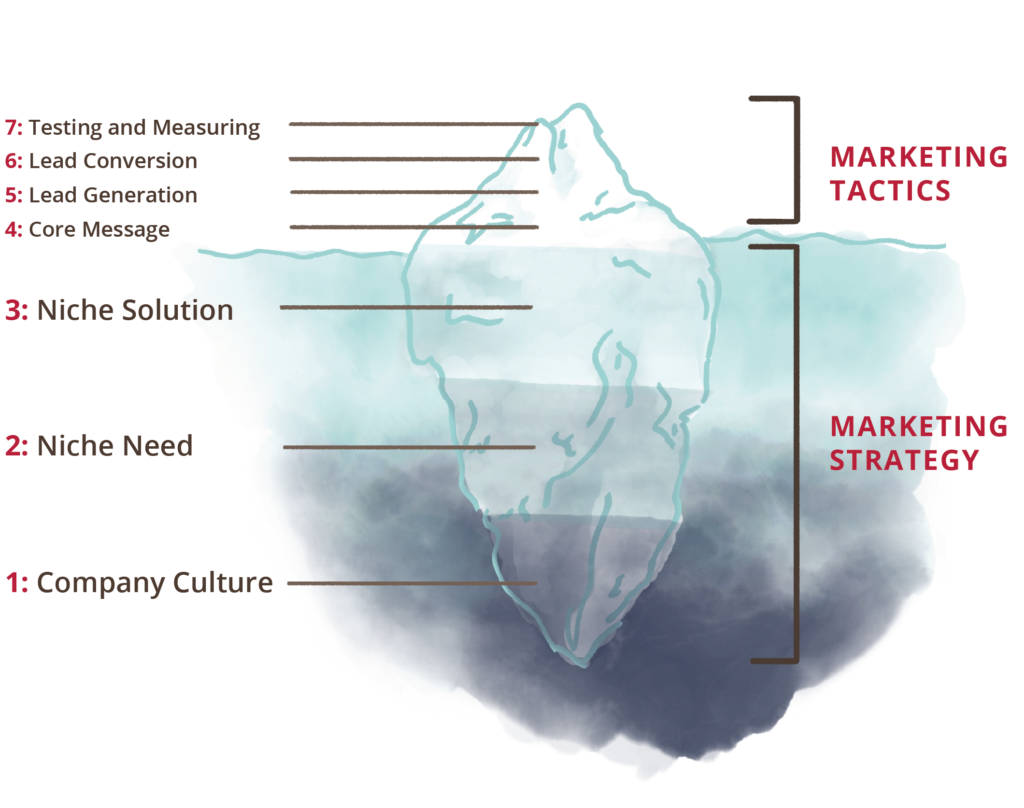
The Triple Foundation of Strategy
If you lay down the first three layers of strategy well, then you can be successful even if you do a mediocre job in the tactical layers from four through seven. But if you don’t get strategy right, you can do an excellent job at the tactical layers and still never find sustainable success.
These three layers of strategy are like the bottom 90% of an iceberg below the water line. They’re difficult to see, but they’re actually the part of the iceberg that catches the current and creates movement. Often, when people use the word “marketing,” they’re not even thinking about company culture, niche need, and niche solution.
They’re thinking about the other four layers of tactics that we’ll address next. They’re thinking about the 10% above the water line that they can see.
When people conclude that marketing doesn’t work, it usually means they threw dollars at tactics but haven’t put thought into strategy. Spending money on tactics without developing a proven strategy is a very high-risk gamble.
Let’s assume now that you have developed a meaningful strategy. Do you even need tactics? Won’t people beat a path to your door? People will only beat a path to your door if you make sure that they see what you have to offer. That is the value of the tactics. The tactics are the 10% above the waterline that the people do see. Even though they’re only 10%, they still play a critical role. The four layers of tactics serve to communicate your good news to your niche market.
Tactic
Layer 4: Core Message
Your core message is the 1-3 things your market needs to understand so they realize the value you create by solving their problem. The core message shows them why they’re better off parting with their cash to experience the solution.
The core message should be used consistently in your marketing, both in layer 5 lead generation and in layer 6 lead conversion. The terminology and wording in your core message can be drawn from statements that your hear your ideal customers saying. Using their words makes it relatable to the other people in your niche market who think and talk like them.
Tactic
Layer 5: Lead Generation
Lead generation is what we do to make connections with new people who might be interested in our product. We want them to raise their hand and say, “I am interested in a conversation.” Once we begin a conversation with a new lead, we move into the lead conversion process.
Tactic
Layer 6: Lead Conversion
Lead conversion is all about helping the prospect make the best decision for them. We should educate them and guide them so that they can make the best choice. This can include choosing the right product from your lineup or even choosing a competitor if that is in their best interest.
Tactic
Layer 7: Testing and Measuring
Testing and measuring should be baked into all seven marketing layers. It’s an inherent part of the three strategy layers, but it also applies to the tactics. When we invest dollars in lead generation for print advertisements, billboards, or online marketing, we should find a way to measure the results so we can make changes and test whether a different approach works better or worse.
The same is true for lead-conversion tools we might use in our sales process. Changing the tool can increase or decrease the percentage of leads that convert to paying customers.
Why Marketing Foundations Matter for Our Communities
In the introduction of this article, I stated my growing conviction that in order for our communities to thrive in this environment of business as the new farm, we need to figure out how to do marketing well. Sustained business success that supports our families’ and communities’ needs depends on these marketing foundations. Here are three reasons why I feel this matters.
Firstly, in a world of constant change, your buyer’s needs and preferences will change. If you don’t ground your company in the foundational aspects of marketing, promote intentionality within your company culture, understand a niche need, and develop a niche solution that your customers love, it’s only a matter of time before the value of what you’re offering today disintegrates and could even go away completely. For most of us, it’s not a matter of if, but when.
Secondly, as we launch new businesses, we need to understand customers’ needs and preferences at the strategic level so we can start strong. When we started new farms, we knew what was needed and how to go about it. As young men jump into business over the next 30 years, their businesses will be much healthier if they understand the foundational aspects of marketing strategy. Then they can build a business plan that’s much more likely to succeed, rather than struggling against the competition.
Thirdly, in the farming days, there were plenty of opportunities for generations to work shoulder to shoulder and build cross-generational relationships. But now that business is the new farm, we have a challenge to maintain family togetherness. If we are creative in developing solutions for our customers’ needs, we will be able to find opportunities for our families to spend time together, whether inside or outside of the business context. Deeply understanding the customers’ need and then developing a solution to meet that need in ways that complement our family values will allow us to have businesses that support healthy families, healthy communities, and healthy churches instead of reducing the amount of time and connection that we have with one another.
Consider the three foundational layers of your marketing strategy. Is your company culture designed to deliver what your customers need and want? Do you really understand the niche need that you are serving? Have you developed the optimum solution to meet that need?
Choose one thing to work on and start improving your marketing foundation.
God bless you with wisdom and courage to sow seeds in your field of business that will yield a harvest of blessing in your community 30 years from now.