“It’s lonely in the wheelhouse,” Mike contemplated, driving to the meat shop on a mid-winter morning. Having been in business now for five years, routines had emerged, but on a cold, gray day like this, Mike missed the primitive days of simply being a meat cutter at Ameripac.
That evening, Mike clued in his wife. “I know we need more sales. I’m pretty sure we have found our niche in
the market, but what should we do next, and how do we go about it?! I don’t know where to aim – I’m alone on this hunt for more business and need a guide.”
“Yes, that makes sense. If we’re going to grow the business enough to involve all the boys, we’ll have to figure out how to keep the business growing,” she reflected. Working with the boys was one of the reasons Mike had started Mike’s Meats in the first place. “Why don’t you call Uncle Fred again? He’s someone you can talk to, and I’m guessing he will have some ideas or at least some direction for you.”
Uncle Fred was glad to listen. Mike told him everything: the need for more business, the emerging market niche, especially the multiple grill-ready entrees and increasingly popular snack sticks. He told Uncle Fred of his sense of loneliness and lack of clarity.
“Remember when you were on the tractor at home trying to make a straight row planting corn? You would set a marker in the distance and drive towards it: a tree, a fence post, the neighbor’s barn. That’s what you need. Markers in the distance to steer toward.”
Mike wrote down “Goals”, and kept listening. “Another consideration is how much money you will spend
trying to market your products. It feels uncomfortable to spend money to make money, and you should do it cautiously, Mike. But money thoughtfully spent can make a huge difference; in fact, I think marketing could bring the changes you need. Establish an amount that you are going to spend on marketing for the year, and stick to it.”
Mike wrote down “Budget”, and kept on listening.
“Spend is not quite the right word when it comes to paying for marketing. Invest is more accurate. You see, many business owners freely invest in equipment to enhance their quality or efficiency. It’s easy to pencil out the return on investment when there are measurable cost savings. Savvy business owners view marketing the same way. Investing in marketing that creates more profit is a good thing to do.”
Uncle Fred continued: “The way you achieve your goals is to get the tractor in gear and drive towards the markers in the distance. In other words, determine what projects are the best for moving the company forward towards your goals. It might be multiple projects, but considering your size and resources, you might do better to focus on one good goal rather than trying to drive toward multiple fence posts.” Mike wrote down “Projects”, and kept on listening. Uncle Fred wasn’t finished yet.
“Everything we just discussed is useless if you don’t implement it. The tractor needs to be hooked to an implement to be worthwhile. Your projects need a time frame to produce action. Marketing is one of those things that often gets pushed to the back burner because other things seem more pressing. You’ll be tempted to think, ‘I’ll take care of it when I have some free time,’ but I’ve found that hitting marketing goals is too difficult and complex without blocking out time to focus on it. Mike wrote down “Calendar”, while Uncle Fred gave illustrations of how this worked for him in bygone years.
“But there’s one more missing link in all this, Mike. Even with a sensible time frame, plans for projects, budgeted funds, and clearly stated goals, you’ll still have difficulty actually driving the tractor and getting the field plowed without knowing Dad is counting on you and will be checking up on your progress. That’s why I’m offering to check back in a month and see how it is going. Is that long enough to give you time to work on this and figure out your goals?” Mike wrote down “Accountability” before replying.
“Yes, let’s meet again a month from now on the 26th. By that time, I want to be able to report on progress. I will aim to have some goals and projects to report on by then.”

Goals
A long-term objective for Mike’s Meats is to increase sales sufficiently to effectively employ the boys over the next four years as their schooling is completed. Breaking this long-term objective into annual goals will increase the likelihood of this being achieved.
Purposeful Planning is directed by annual SMART1 goals: Specific, Measurable, Achievable, Relevant, and Time-bound. Creating a one-year marketing strategy enables businesses to develop step-by-step plans for achieving their long-term strategy. Like Uncle Fred said, “Identify markers in the distance to steer towards.” Here are some sample annual goals.
• Increase gross sales by 10%.
• Increase monthly sales of kabobs by 50%.
• Introduce 3 new holiday gift packages.
Note the elements of S.M.A.R.T. goal setting in those goal statements. Specific: we know exactly what the focus is. Measurable: a 50% increase. We can easily tell whether we reached the goal or not. Achievable: the goals are realistic for our current situation. Relevant: current kabob production isn’t using all the premium off-fall created by premium cuts; premium scraps are currently going into hamburger. Time-bound: an annual goal.
Some marketing may be in place and working well on autopilot. An attractive road sign at your place of business was a once-and-done effort that will continue to do its job without the initiative and effort required to integrate the goals of the one-year plan.
Some marketing goals can double dip. For example, Mike implemented a referral program that promotes kabob awareness. Mike’s customers can give a referral card to anyone for a free pack of kabobs. The customer who gave the card also receives a free pack on their next visit. This not only promoted customer traffic and overall sales, but also increased the volume of kabob sales. No more high-quality meat scraps are being “wasted” in hamburger.
Budget
Mike and his team also had an objective to develop sales brochures. Unlike the kabob referral program, this project needed a specific budget. Mike allocated $12,000 over the next three months to the development of a new brochure. The brochure would be made available to customers in- house, and at other business locations of parallel industries such as outfitters, gun shops, feed stores, and farm and ranch suppliers. It was also designed to be used in an “Every Door Direct” mail campaign. This project required careful allocation and tracking of funding, as it would have been easy to spend double the budgeted amount without
even realizing it. Budgeting is a highly contextual consideration. The price of the item being sold, the projected number of sales, and many other factors, such as potential market size, are all key considerations when creating a marketing budget. Massive amounts can be spent on marketing initiatives, and that’s why some form of measurement for the return on investment is essential.
Projects
A Purposeful Planner takes a goal and creates a project (a method) to achieve it. A business may have several projects all pushing simultaneously towards the same goal. These projects are best achieved when managed by the “Triple Constraints”: (1) deadlines, (2) budget, and (3) performance.
The brochure project was managed by the triple constraints. Assignments with deadlines were given for photoshoots, text, and design layout. Once the brochures had been produced, mailed, and placed in various businesses, Mike began tracking the number being moved, monitored customer comments, and kept a count of how many free kabob packs were handed out.
Calendar
By watching Mike’s Meats, we can see how important time frames are in advancing marketing projects. Mike
knew that he had another meeting with Uncle Fred on the 26th, and he would need to report on what he was trying to accomplish (goals) and how he was going about it (projects). Mike decided to block out two times on his calendar over the next three weeks to make sure he would accomplish his tasks.
Mike and his team also discovered how complex a simple marketing project can be. Before a brochure can be distributed, it needs to be produced. Before it can be produced, it needs to be designed. Before it is designed,
the photos must be shot. Before that, Mike wanted to tweak the product a little; he had some changes he needed to test on several of the featured entrees. Mike quickly realized that if they were going to have a brochure within the next three months, he needed to establish a clear path
with milestones and schedules. Mike created a marketing calendar where all these task deadlines and project deadlines could be marked. That way, everyone involved could see what needed to be done by when.
Accountability
After Mike met with Uncle Fred for several months, he realized how much the accountability meeting motivated him to get his stuff done. He decided to have weekly accountability meetings with those involved, where progress would be reported. These meetings were put on the calendar. He began to manage meetings using the acronym “WDWBW” (Who Does What By When). It was all part of purposeful planning.
The Rest of the Story
How did these various projects work out for Mike? The referral program increased customer traffic. It quickly
became useful for highlighting both new product releases and established favorites. One small indicator of its
effectiveness is that the referral card tack board behind the checkout needed to be alphabetically arranged with permanent letter headings because of the volume of referral cards waiting to be redeemed by the originator.
Brochure effectiveness was harder to track. Mike discovered that not all the customers brought in by the brochures asked for the pack of kabobs. He also discovered some repeat customers were asking for them. But Uncle Fred told him not to worry too much about it. “You know enough to know it’s working well, and that’s what counts, he said. Purposeful planning starts with setting SMART goals. Then you can determine an appropriate budget, plan projects to invest in, and create a calendar to schedule time to work on them. Most importantly, arrange an accountability partner to help you stay on track.
Evaluate Your Business
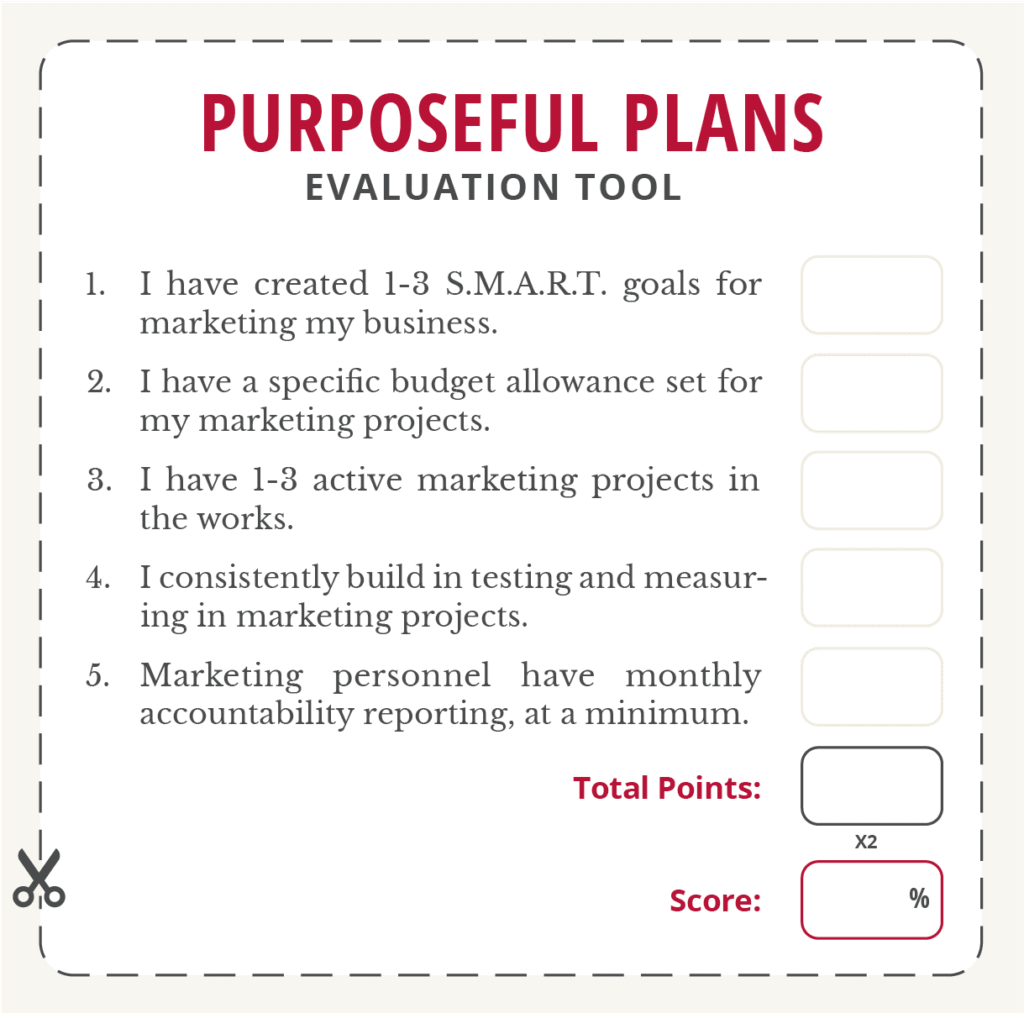
Here’s an evaluation tool to help you determine the strength of your marketing plans. Evaluate each indicator on a scale of 1 -10, with 10 being the highest.