
One warm summer afternoon, a small, unidentified pickup truck zoomed unexpectedly onto the job site where a crew was working to frame a new house. A chest freezer filled with premium meat cuts bounced on the truck bed, and a forward-leaning salesman with arched eyebrows leaped out, ready to show off his product to the hard-working crew. How many 50-lb. promotional family packs, his only product of the day, do you suppose he sold to that crew? Fortunately, this business was mobile, and he could zip on to other folks.
No matter how lively the man or his idea, lead generation will fall flat in those conditions. Carpenter crews are not well-positioned to receive 50 lbs of meat. Perhaps if it were wintertime… but even then, better leads exist among the kitchen crowd, rather than the builder bunch. While his product was enviable and the crew all had ample cash in their wallets, he sold nothing.
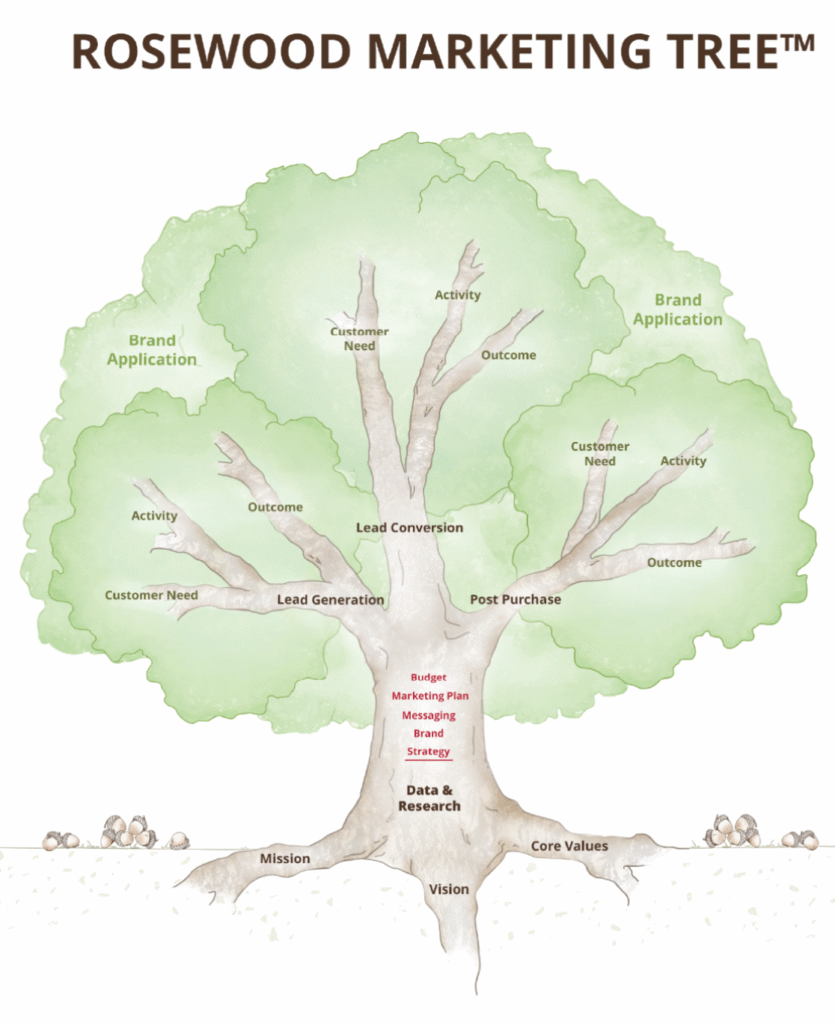
For the past year in this article series, we’ve been making our way up the Rosewood Marketing Tree. Starting with the roots of the business (core values, mission, and vision), we moved on to the trunk (strategy). Now we are ready to consider the branches. The branches contain lead generation, lead conversion, and post-purchase activities. These subjects are function-focused instead of foundational and strategic. This is where we get into the doing of marketing. This article will focus on lead generation. Then, we will look at lead conversion and post-purchase activities in the next two articles.
What is lead generation?
Lead generation is a function of marketing: identifying potential customers and getting permission to start a dialogue with them.
The marketplace has many potential customers. Lead generation is the process of finding those who are interested in your offer. For someone to become your customer, they must first discover what you offer.
You haven’t generated a lead until you have their contact information and permission to communicate. This allows a dialogue to start. Many businesses have software for managing lead lists, but it can be as simple as a handwritten notebook. When you have their contact information, you can follow up with them.
What are the conditions under which lead generation can occur?
For lead generation to happen, three basic conditions must be met. First, a business must be made visible where the leads are. Secondly, it must be the right time. For example, to successfully market clothing for extreme weather, I must reach out to people who live in Siberia, Wisconsin, or other regions with harsh weather. It won’t be easy to find users interested in purchasing extreme weather gear during the surprisingly balmy summers of the Northern regions.
The correct time and place are key. That’s why your dad always said, “Business is good when you’re at the right place at the right time with the right product.” And Uncle would always follow up, “Yep, you can’t sell ice to an Eskimo!” In the story at the beginning, the salesman ignored time and place considerations. Despite his lively effort, lead generation wasn’t so lively; it flat-lined.
What are the fundamentals of lively lead generation?
For lead generation to work in the lively manner we are aiming for, the correct crowd must be identified. In a previous article on strategy, we addressed the subject of a customer persona. Knowing as precisely as possible the characteristics of the person we are trying to reach is key. The question then becomes how to reach them.
Methods for reaching people abound. Identifying the potential customer’s habits and haunts often points us to being in the right place at the right time.
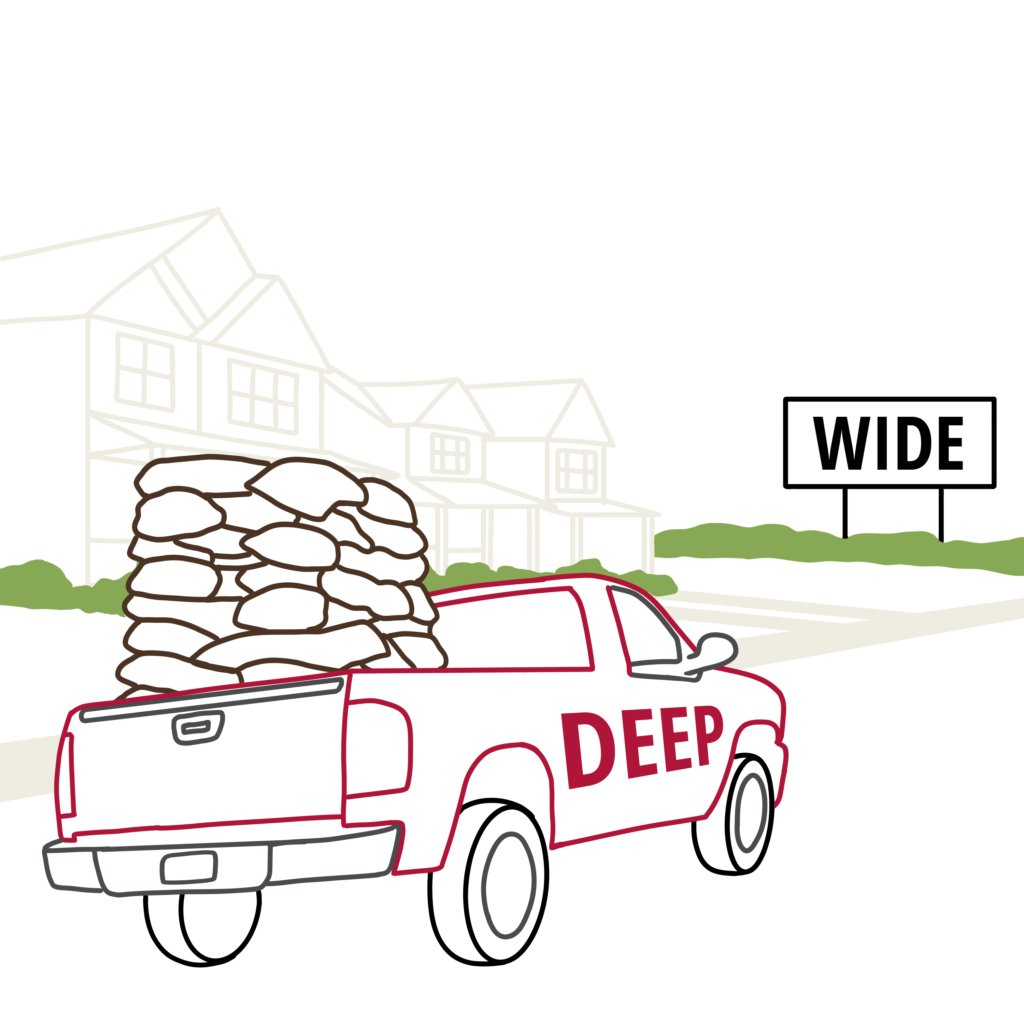
Marketing strategies fit into one of two approaches: deep or wide. By deep, we mean that a relatively large amount of resources is spent on a small, tightly targeted group. Deep marketing is used when the audience is small but highly valuable.
Merv’s Mulch uses deep marketing in housing subdivisions with extensive landscaping and flowerbeds. First, he and his children fill one-gallon zip-lock bags with premium mulch product. Each bag is neatly labelled with the product description and the contact information for Merv’s Mulch. Merv’s wife, Sylvia, drives the pickup loaded with pallets of prepared mulch bags. Up and down the streets of select subdivisions they go, Merv and the children delivering them on foot to hundreds of front porches. It’s hard to ignore a gallon bag of mulch. Anyone who is slightly dissatisfied with their current supplier is likely to try out this new option. Or, Merv might get the business simply for showing up at the right time.
Wide marketing describes an approach of spreading resources across many potential customers. It’s understood that most of them won’t be interested, but some might be, and it’s important to identify which ones are. Wide marketing includes mass mailers, billboards, and other channels that reach a broad audience.
Merv’s Mulch also uses direct mail to get into every house in the county. Getting gallon bags of mulch into the hands of all those people would be impractical and very expensive. So, wide marketing also has a place in Merv’s strategy. Wide marketing can be a good investment in the right scenario.
Lively lead generation requires carefully considered content. Your entire advertising content needs to get the prospect thinking, “They get it! They understand! They have the answer to my problem!” Well-crafted and effective advertising content will connect with your audience. The prospect will feel understood. (Read more about content connection in “Magical Messaging,” our October 2025 article.)
Testing and measuring
It is important to test and measure the effectiveness of the money spent on lead generation. While sophisticated tracking software exists and is sometimes helpful, another method is much more straightforward. A paper, a pencil, and a question might be all the mechanisms needed to track lead generation: “How did you hear about us?” Reviewing the paper every month often yields surprising information you can use to make better decisions.
Tracking lead generation can help you know what advertising works and what doesn’t. Tracking, comparing, and adjusting is a journey of experimentation best led by data, not just gut feelings. Tracking lead generation can tell you where you are wasting money. Then you can lower your investment or put those dollars to better use in channels that are generating leads.
There’s no need to stress over the difficulty of testing and measuring advertising effectiveness. If you can track 80% of your lead-generation activities, that is sufficient to gain an overview of what is happening. Don’t be careless about your advertising budget—those monies matter! Just as a carpenter is concerned about hitting the nail on the head with predictable precision, so is the marketer concerned with testing and measuring advertising, so he too can be successful.
What are some tips for lively lead generation?
Offering a valuable item in the advertising itself can be quite effective. For example, an advertisement that provides a free, worthwhile piece of information will be more readily read and remembered: “Eyeglasses tip #12,” “Homer’s housecleaning tidbits,” etc. One electrician kept changing out his “shocking facts” at the bottom of his ads. “A 100-watt incandescent bulb left to burn overnight will use as much power as a well pump needs to fill the lighted area to an approximate depth of 3 feet.” This type of information in your advertising gets people thinking and engages them. They will look for the next ad in the next issue, and sure enough: “A standard hot tub will add approximately $60 to your monthly electric bill.” This type of “free” info is valuable to people, contributes to their well-being, helps root your business in their minds, and builds trust.
Remember Mike’s Meats and his legendary snack sticks? Mike offers free insights and observations on what makes a great snack stick. (He’s the master of snack sticks, after all.) Mike has found that providing engaging evaluation tools in his advertising generates snack-stick leads.
Over time, Mike has invented a dozen creative ways to serve up snack sticks in memorable ways. He calls this “Serving Snack Sticks 101” and incorporates it into his advertising. At the beginning of November, he published his snack stick version of a gingerbread house that mimicked a log cabin. After his youngest son’s birthday, he showed a picture of the “cake”: a tastefully done Steam Engine, complete with train tracks. Eighty percent of the components were snack sticks. Each of Mike’s creations was followed by a few suggested occasions where it could be used and wrapped up with a call to action: “Get the directions and all the supplies in our store or order at mikesmeats.com.”
Creative lead generation continues to bring in people who have seen the ads and want to elevate their guests’ experience. Plus, they are always looking for the next creative reveal. The best part is that customers have started sharing photos of their own creations that were inspired by Mike’s example.
Past customers are your best leads.
Another tip: remember your past customers. This is a very rich treasure trove of leads! Don’t ignore them! It’s natural to chase the new. But that’s not always the most sensible course. If a customer has been satisfied once, reminding them of that satisfaction may be the key to more business.
Former customers are your best leads because important parts of lead generation have already occurred. Compared to new contacts, past customers are less costly to reach and serve. They know you, and you know them, which increases both the efficiency and effectiveness of the transaction. You have already done business with them. You’ve already moved them through the steps of lead conversion and won their trust. Being already “half led” and “half converted,” they are a ripe and logical place to pitch your new product or service.
One mini-barn builder tapped into a very robust market by advertising to previous customers. Instead of being stuck in the thought, “they already bought a shed from me,” he worked off the premise, “they might really want to upgrade.” With a message focused on upgrading through a simple trade-in program, two sales resulted from each repeat customer. First, he sold them a new shed, and second, he now had a used shed to sell to a different market segment that proved very eager to buy. A good business model includes serving past customers well with advertising geared especially for them.
A former customer can be your best advertising agent. A comment such as, “I bought my last pair of glasses there and was really satisfied,” is what led me to choose my current eyeglasses retailer. You can’t go wrong generating referrals from people already warmed to you and your business. Sometimes the situation affords a deep marketing method, such as putting a previous customer in contact with a potential one. You could meet for lunch with the three of you. Or, if your customer loves to show off their new kitchen, you might get a call from their neighbor who just had a tour.
Co-op advertising
Another tip: utilize co-op advertising programs. If you are selling someone else’s product, they might partially pay or even completely pay for your advertising of their product. For example, Mike’s Meats sells high-quality knives. Mike cashed in on the knife company’s offer to cover 50% of the advertising costs. These advertisements included his business name and meat products along with the knives. That is a win-win! One year, Mike gave a new steak knife with every beef butchered. The company gave those promotional knives to Mike’s at 50% of the wholesale price. Folks began to want entire knife sets. Nobody complained! Everyone benefited.
Make sure people know what to do.
One last tip: be sure to include a call to action (CTA) in your advertising. “Find out more at mikesmeats.com” or “Call today—ask for Mike” both tell people exactly what the next step is. We move to action much more readily if we know exactly what to do. By the time Mike’s prospective customer gets done admiring his newest creation in “Serving Snack Sticks 101,” they are ready to do something about it, and Mike’s advertisement tells them precisely what to do.
A CTA can be coupled with an offer for a free resource in exchange for an email address. A mini-barn business might advertise, “Try our free shed evaluation tool on our website.” Or a furniture store can invite folks to “Find out the top five furniture buying mistakes of new home buyers.” Mike’s entire “Snack Stick Appreciation 101” compilation is available on his website, provided you give your email address and agree to receive periodic promotional mailings. This allows him to provide more information than can fit in a standard advertisement. It is truly a triple-whammy! First, you have engaged them in interactive, effective advertising. Next, you have provided them with helpful information. Third, you have harvested their email and received their permission for future communication.
Conclusion
Businesses don’t have “current customers”; they only have former or future ones. The term current customer is correct only for the brief moment of the transaction itself, that short time when both the seller and the buyer have their hands on the cash.
We tend to push back on this concept because it seems too extreme, too narrow. “I have a contract.” “I know they are going to pay.” “We have a relationship of trust that goes way back.” But a contract can be reneged. Or surprise!—the long-standing customer stops ordering. The chart of accounts has “bad debt.” The realities of the most loyal customers can change, and you may suddenly find yourself outside their circle. Practically anything can happen. The person you regarded as a “current customer” may turn out to be only a past customer. Why? Because that’s what they were 99% of the time in the first place.
That’s why you need lively lead generation: for that crucial 1% moment.
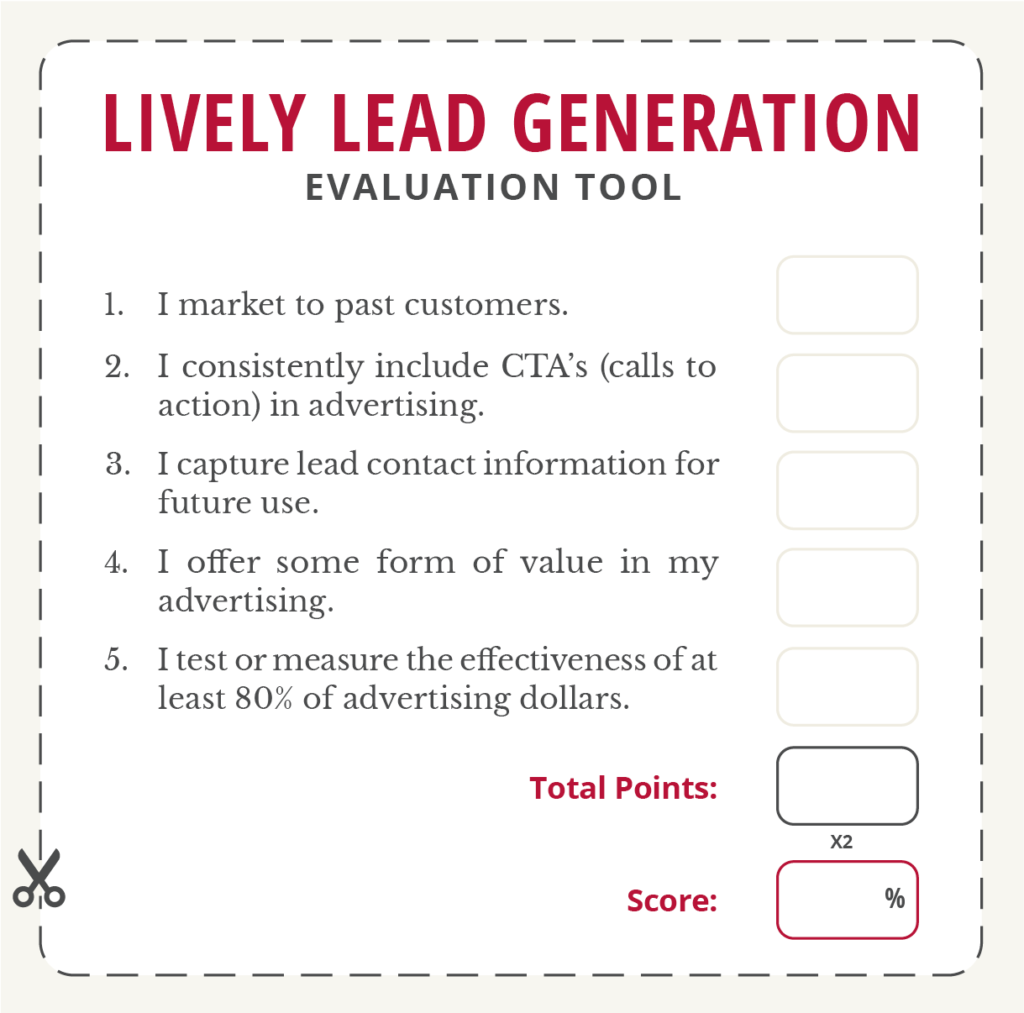
Use this evaluation tool to index the “liveliness” of your lead generation. On a scale of 1 to 10, rate yourself in these areas. Then generate a score and listen to the story it tells.
Follow us on…